
For most buyers, "sampling" is a four-week gap in the inbox between sending a brief and a courier arriving. Inside that gap, a custom furniture sample passes through 12–14 distinct steps. Understanding those steps changes how you brief, how you review and how you sign off — which changes how the bulk run behaves.
This is the full sample cycle, the way we run it.
Step 1 — Brief intake (Day 1–3)
The buyer sends one or more of:
- A drawing or CAD file
- A reference image
- A written description
- A swatch board or finish reference
- A target FOB band
We come back with one of three outcomes: "We can make this exactly," "We can make this with these specific changes," or "This is not in our category." Honest categorisation here saves everyone time.
Step 2 — Spec sheet draft (Day 4–7)
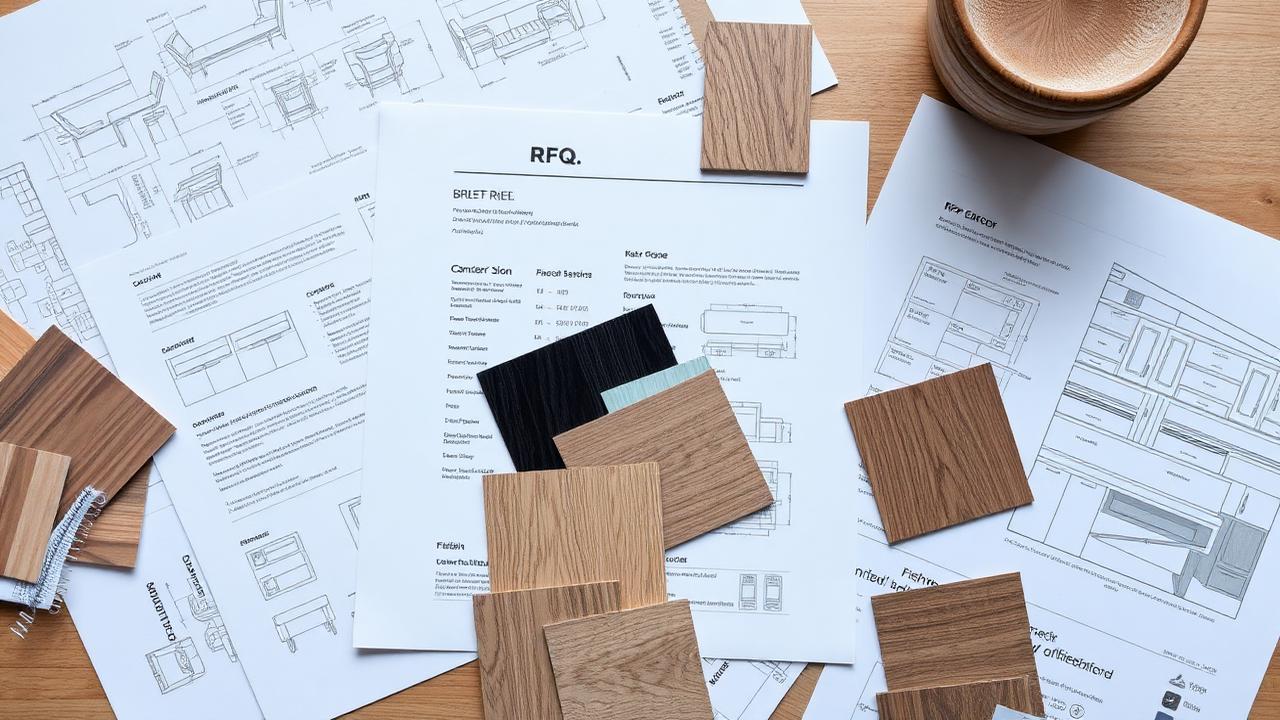
We translate the brief into a buildable spec sheet:
- Materials with botanical names and grade
- Construction method (joinery type)
- Dimensions with tolerances
- Finish specification (colour reference, sheen, layers)
- Hardware spec (brand or grade)
- Packaging spec
- Target FOB
The buyer signs off on the spec sheet before we cut any wood. This single document is what the bulk run will be built against.
Step 3 — CAD / shop drawing (Day 7–10)
The spec sheet becomes a shop drawing — every component dimensioned, every joint detailed. For complex pieces, a 3D render is shared with the buyer as a sanity check before sample build starts.
Step 4 — Material selection (Day 10–14)
The shop floor selects the actual timber boards from stock, the finishes from the supply, the hardware from the BOM. For visible-face pieces, individual boards are matched for grain and colour.
Step 5 — Component manufacturing (Day 14–22)
CNC routing, manual machining, planing, edge profiling, joinery cuts. Components are dry-fit before glue-up.
Step 6 — Assembly (Day 22–26)
Glue-up, clamping, dry curing, structural QC.
Step 7 — Sanding and finishing (Day 26–32)
Multi-stage sanding (P80, P120, P180, P240 typically), stain or sealer application, multiple finish coats with light sanding between coats, final polish.
Step 8 — Upholstery (if applicable, Day 30–35)
Frame inspection, foam cutting, fabric cutting (matching pattern where applicable), stitching, upholstery fitting, button or stitch detail.
Step 9 — Pre-shipment QC (Day 33–36)
Sample photographed from 12 angles, dimensions measured, finish inspected, hardware tested. Sample held against the original spec sheet line by line.
Step 10 — Packing (Day 35–37)
Custom-cut foam, double-wall carton, labelled outer.
Step 11 — Despatch (Day 37–40)
Courier (DHL, FedEx) or sea-freight for larger samples. Buyer receives tracking.
Step 12 — Review at destination (Day 45–55)
Buyer inspects, photographs, compares to original brief. One of four outcomes:
- Sign-off as-is → spec locked, bulk PO can be placed
- Minor revisions (finish, fabric, dimension) → revised sample in 10–14 days
- Major revisions (construction, scale) → full re-build, 21–28 days
- Project drop → both parties walk
Step 13 — Spec lock (Day 55–60)
The approved sample becomes the "master sample". A signed sign-off form locks the spec. Every bulk piece will be QC'd against the master.
Step 14 — Master sample retention (forever)
The master sample stays at the factory in a labelled retention shelf, photographed and tagged. For any QC query during bulk or re-orders years later, the master is the reference.
What goes wrong, and how to avoid it
The five recurring failures on sample programs:
- Vague brief, vague sample. The fix: detailed spec sheet
sign-off before cutting wood.
- Verbal-only revisions. The fix: every revision in writing
with reference images.
- **Sample built by senior craftspeople, bulk built by less
experienced ones.** The fix: master sample on retention shelf for bulk QC reference.
- Buyer signs off in a hurry, finds issues in bulk. The fix:
give the sample two weeks to live in your space before signing.
- Re-sampling without a defined change list. The fix: a
written "change list" between rounds, not a phone call.
Frequently asked
Is the sample free?
Sample cost varies by complexity. Most samples are paid for and often credited against bulk PO.
Can I see the sample in progress?
Yes — we share progress photos at machining, glue-up, finishing and packing stages.
How many revisions are typical?
One or two rounds is normal. A program needing more than three usually has a brief problem upstream, not a sample problem.
Statistics referenced in this briefing are drawn from D' Emporio's proprietary research and stakeholder knowledge. The information remains the proprietary information of D' Emporio Global Pvt. Ltd.