
If you are buying wooden furniture in Asia, you are usually choosing between three countries: India, Vietnam, Indonesia. Each has a real specialty, a real weakness, and a real cost structure. The honest version of this comparison rarely shows up in supplier pitches, so here it is.
WHAT EACH COUNTRY ACTUALLY MAKES WELL
India is strongest in:
- Solid wood case goods (sheesham, mango, acacia, teak)
- Hand-carved and detail-heavy pieces
- Metal-and-wood mixed materiality (industrial, contract)
- Cotton, jute and natural fiber upholstery
- KD / flat-pack with optimized container density
- Architect-led custom programs (the case is growing)
Vietnam is strongest in:
- Engineered wood seating at volume (dining chairs, stools)
- Outdoor furniture in acacia and synthetic rattan
- Upholstery sofas and recliners
- Large-scale, predictable, repeat catalog programs
Indonesia is strongest in:
- Solid teak (legitimate FSC-certified Javanese teak)
- Rattan and natural fiber (Cirebon belt)
- Hand-finished signature pieces
- Indoor-outdoor crossover for resort projects
These specialties are not absolute — each country has factories that do everything — but the country-of-origin advantage shows up in pricing, lead time and quality consistency.
WHERE THE WORLD IS BUYING FROM INDIA
A simple lens: who is actually putting their hand in their pocket to buy Indian furniture today?
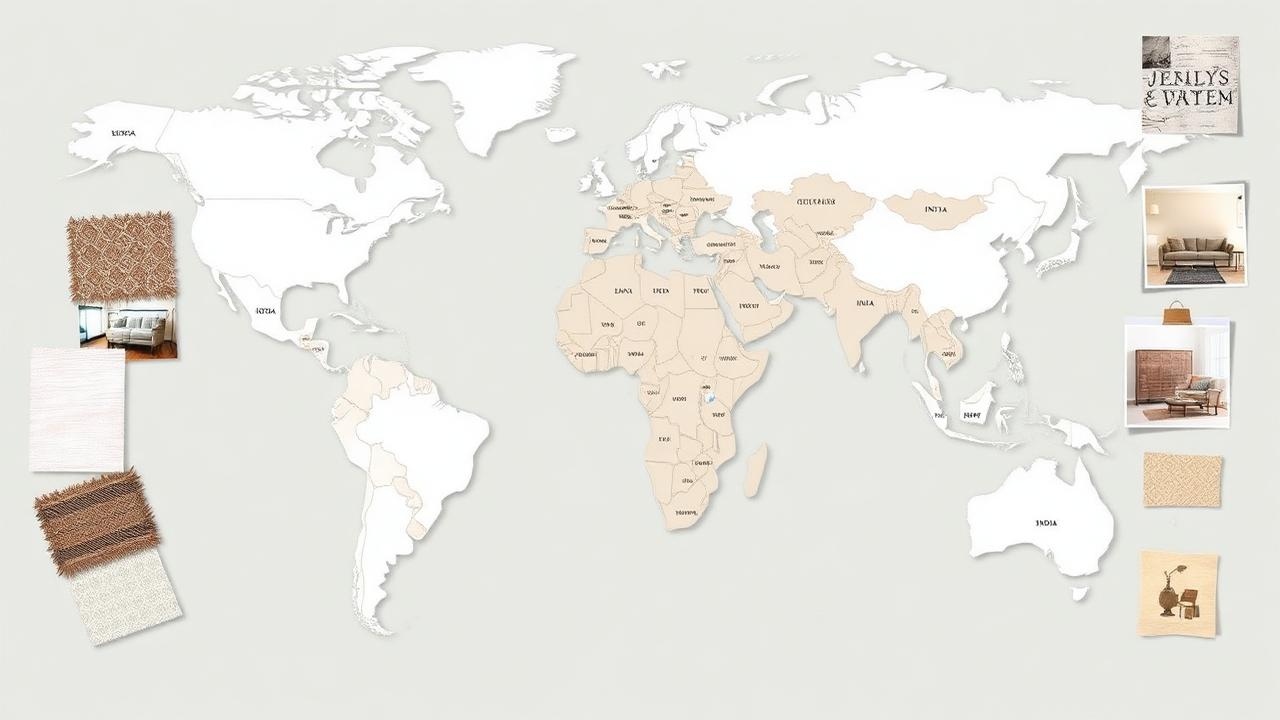
Top destinations for Indian furniture exports, recent months, D' Emporio proprietary research:
United States INR 467.33 crore 23,277 shipments Germany INR 97.05 crore 4,400 shipments Netherlands INR 65.27 crore 5,181 shipments United Kingdom INR 52.50 crore 3,823 shipments France INR 41.21 crore 2,259 shipments Spain INR 37.96 crore 2,420 shipments UAE INR 36.28 crore 2,721 shipments Canada INR 25.98 crore 2,023 shipments Australia INR 17.78 crore 1,828 shipments
Source: D' Emporio proprietary research via D' Emporio Global / D' Emporio researchresearch, recent months.
USA at 44 percent of total Indian furniture exports is the most important data point in the table. It tells you that whatever you are sourcing from India, there are dozens of buyers ahead of you who already pressure-tested the supply chain to the US market. The compliance documentation (BIFMA, CARB, US FDA where relevant), the freight lanes (Mundra → US East and West Coast), and the legal frameworks are well-trodden.
European demand at over 30 percent combined is also significant and rising — Germany, Netherlands, UK, France, Spain, Belgium, Poland all show meaningful volumes.
COMPARING ON THE ACTUAL BUYER DECISIONS
When you put the three countries side by side on the things buyers actually decide on, the picture looks like this:
Price (FOB, broadly comparable item):
- Vietnam: lowest at high volume
- Indonesia: mid, premium for teak
- India: competitive on solid wood and KD, premium for architect-led custom
Lead time (typical custom program):
- Vietnam: 60–90 days, very predictable
- Indonesia: 90–120 days, sensitive to teak supply
- India: 90–135 days, sensitive to fabric/finish complexity
Minimum order quantity flexibility:
- Vietnam: high MOQs, rigid
- Indonesia: moderate MOQs, some flex
- India: highly flexible — 1 x 40' HC programs are normal
Design collaboration:
- Vietnam: limited, mostly catalog-led
- Indonesia: limited, signature-piece-led
- India: strong on architect-led custom
Certification depth:
- Vietnam: FSC, BIFMA widely available
- Indonesia: FSC strong on teak, BIFMA emerging
- India: FSC, BIFMA, GREENGUARD, EPCH, ISO 9001/14001/45001 all common in serious factories
Geopolitical risk:
- Vietnam: US-China trade tensions can spill over into Vietnam component sourcing
- Indonesia: stable, export-friendly
- India: stable, export-friendly, growing free-trade-agreement network
WHEN INDIA IS THE OBVIOUS CHOICE
If your program ticks two or more of these boxes, India is usually the right answer:
- Solid wood, not engineered
- Architect or designer in the loop
- Custom dimensions or finishes
- Mixed materials (metal + wood, stone + wood, cane + wood)
- Smaller MOQ per SKU, multiple SKUs in one container
- Hand-finished elements
- US or European compliance package required
- You want a real conversation, not a catalog PDF
WHEN VIETNAM OR INDONESIA IS PROBABLY BETTER
Be honest with yourself. India is not the right answer for every program. Vietnam is probably better when you need 4–6 containers per month of an identical engineered SKU at the lowest possible price point. Indonesia is probably better when the project specifies teak across the board, especially for resorts in tropical climates.
A mature buyer often runs all three countries in parallel — and that is not a bad strategy.
Frequently asked
Is India cheaper than Vietnam?
Not at the engineered-wood, high-volume catalog level. Often yes at the solid-wood, custom, lower-MOQ level.
Can India match Vietnam on lead time?
For comparable programs, India is typically 15–30 days longer. The gap closes when factory loading is light and widens around Diwali.
Why are so many buyers re-evaluating India in 2026?
Geopolitical de-risking from over-concentration in one country, plus India's improving compliance infrastructure and design-led offers.
Statistics referenced in this briefing are drawn from D' Emporio's proprietary research and stakeholder knowledge. The information remains the proprietary information of D' Emporio Global Pvt. Ltd.